Nuvrake
Trail Module
Trail Module
Couldn't load pickup availability
- 📁 Digital file available after purchase
- 🗂️ Long-term availability
- 🔐 Secure checkout
- 📝 Content updated in 2026
Self-paced learning overview
1. Problem Statement
When a brand already has many learning materials, descriptions, modules, AI prompts, categories, and editorial rules, the main question appears: how to gather all of this into a consistent route. Separate parts can be well prepared, but without a wider trajectory, it can be difficult for a user to understand where to begin, how to move between topics, and why one block leads to another. In SMM, this issue becomes stronger because content, learning, and communication are often created at the same time, but they do not always support one logic. Because of this, the course system may look like a large selection of materials rather than a thoughtful learning trail. Trail Module was created to help gather all Nuvrake parts into one route with defined stages, transitions, and editorial review.
2. Solution
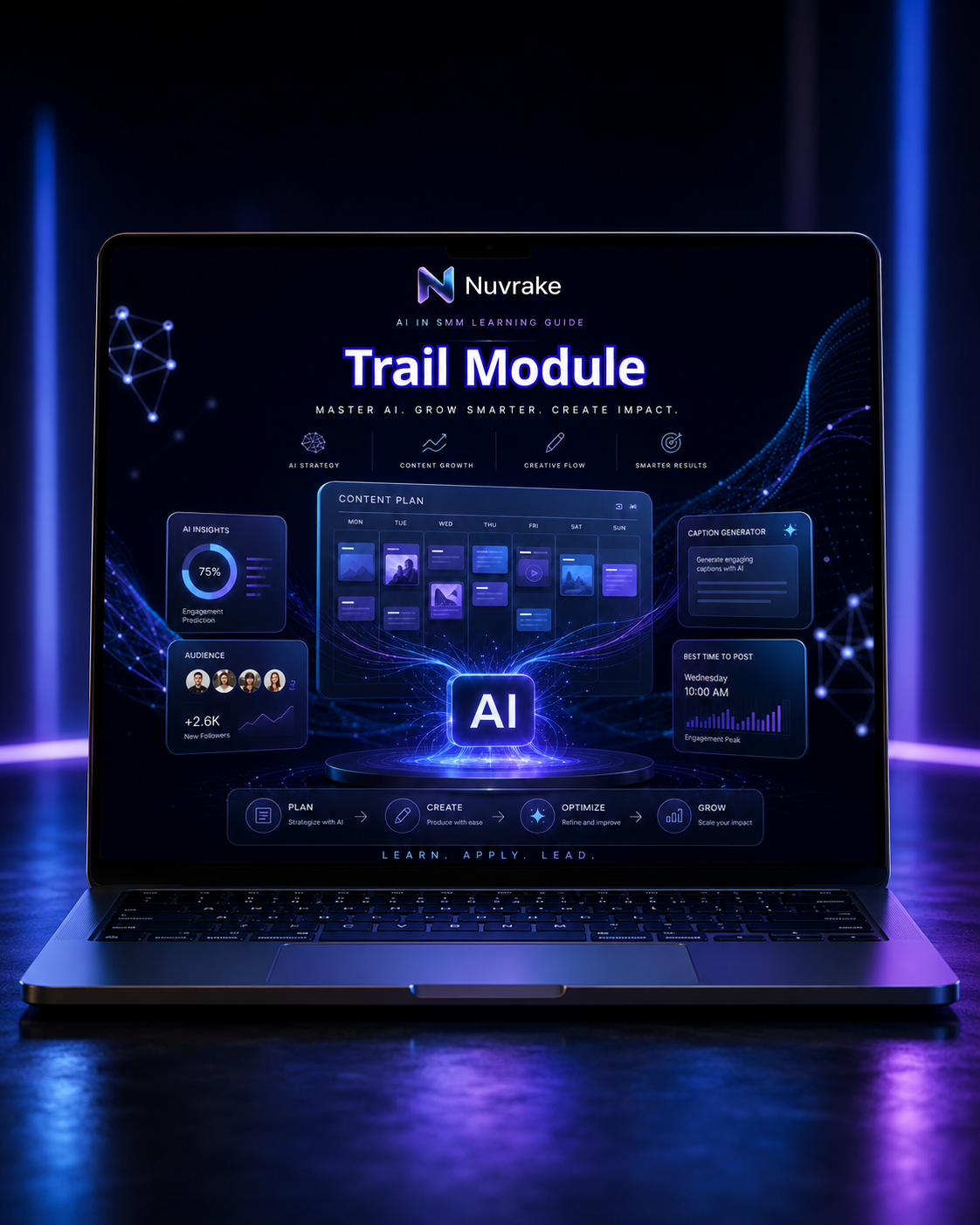
Trail Module shows how to create a full learning route for AI in SMM using already prepared materials. The course explains how to place modules in the right order, build transitions between topics, add introductory explanations, review the tone of the whole system, and prepare page texts for the store. The learner practices seeing not only a separate course or module, but the full user path: meeting the brand, choosing a tier, reading a description, reviewing FAQ, moving to materials, and continuing learning. This approach helps make the Nuvrake line more coherent, calm, and readable. Trail Module is suitable for learners who want to complete the course structure and prepare it for publication work.
3. What’s Inside
Trail Module includes materials for building the full Nuvrake learning route. The first module explains what a trail means in the course logic. It is not just an order of topics, but a sequence of experience: from the first contact with the brand to deeper understanding of AI in SMM. The learner reviews how a person moves between blocks: sees a name, reads a short description, compares tiers, opens FAQ, goes to the Contact or About Us page, and then gets familiar with learning materials.
The second module focuses on the structure of the whole line. Here the learner reviews ten tiers as one system: Free Kit, Pulse Guide, Frame Set, Flux Library, Flow Map, Luma Framework, Vertex Collection, Loom Module, Anchor Module, and Trail Module. Each tier has its own role: start, base organization, frames, library, map, system, collections, modules, reference rules, and full route. This review helps see whether topics repeat, whether each tier adds a new layer, and whether the growth logic feels natural.
The third module centers on transitions between tiers. The learner practices writing short bridges between learning levels. For example, after Free Kit, a person can move to Pulse Guide to work more with prompts. After Frame Set, Flux Library can be a fitting next step when working wording needs to be stored and grouped. After Loom Module, Anchor Module becomes a logical move because created blocks need editorial reference points. These transitions do not pressure the choice; they explain the difference between tiers.
The fourth module focuses on the course page route. It shows how to place texts on a Shopify page so the user receives information in a convenient order: short introduction, problem description, solution, course content, who it is created for, skill list, 30-day request terms, FAQ, and contact block. The learner reviews why it is better not to begin a page with loud claims, but to explain the content, format, and learning logic first.
The fifth module reviews one editorial tone across the whole line. Trail Module helps check all texts: headings, subheadings, tier descriptions, FAQ, About Us page, Contact page, email blocks, and short button texts. The learner reviews whether the brand sounds the same everywhere: calm, meaningful, without pressure, without exaggeration, and without claims about specific results. This block includes a review table: text, task, tone, possible weak points, and editorial action.
The sixth module focuses on AI prompts for building the route. These prompts are not for one separate text, but for reviewing the whole system. For example: a prompt for analyzing tier sequence, a prompt for finding repetition in names and descriptions, a prompt for checking transitions between blocks, a prompt for finding wording that feels too general, a prompt for creating short explanations between modules, and a prompt for softening promotional sound. The learner sees how AI can help not only create materials, but also review them as a system.
The seventh module includes the Trail Module builder. The learner fills in fields: general idea of the line, role of each tier, key topics, transitions between levels, page blocks, editorial rules, FAQ, contact explanations, tone review, material status, and future updates. As a result, the learner forms a map of the whole learning system that can be used while preparing the store, course pages, and future materials.
A separate course block focuses on reviewing growth logic. The learner analyzes whether each next tier truly adds a new meaningful layer: not just more volume, but another learning task. For example, Flux Library does not repeat Frame Set; it adds prompt organization. Flow Map does not repeat the library; it shows the route between materials. Luma Framework does not repeat the map; it creates a working system. Trail Module closes this logic because it gathers all parts into one coherent path.
Trail Module also includes a block about brand pages. The learner reviews how texts on About Us, Contact, FAQ, and email blocks should support the whole system. If the course speaks calmly and structurally, the brand page should sound the same. If tier descriptions avoid loud claims, the email block should not suddenly create pressure. This alignment helps the brand look organized across every communication point.
4. Who Is This For?
Trail Module is for learners who already have a prepared or nearly prepared course line and want to gather it into one route. It is a fitting choice for authors of educational materials, SMM specialists, editors, learning designers, brand owners, and small teams working on a course page launch.
This tier can be useful for those who want to review not only separate texts, but the whole Nuvrake system: tier names, growth logic, page blocks, FAQ, brand description, contact communication, and learning modules. Trail Module helps see whether all parts support one idea, whether there is repetition, whether topics are distributed well, and whether one tone is maintained.
5. What You’ll Learn
- How to create a full learning route for AI in SMM.
- How to connect all tiers into one logic.
- How to define the role of each course in the line.
- How to create transitions between learning levels.
- How to review a course page before publication preparation.
- How to analyze FAQ, Contact, and About Us within one system.
- How to use AI prompts to review the whole line.
- How to find repetition in descriptions and modules.
- How to soften wording that feels too promotional.
- How to keep one tone in headings, descriptions, and learning blocks.
- How to create a tier map for internal work.
- How to review the growth logic between tiers.
- How to prepare editorial notes for future updates.
- How to gather AI prompts, modules, collections, and page texts into one system.
6. 30-Day Payment Review Note
Trail Module includes a 30-day period for payment review requests if the materials do not match the tier description on the page or if technical issues occur when receiving the learning files. The user can contact the Nuvrake team within 30 days after checkout. We review each request separately, compare it with the tier terms, and help find an appropriate resolution. This section is created for transparent communication between the user and the brand without pressure, exaggeration, or loud claims.
Do I need previous experience with AI or SMM?
Do I need previous experience with AI or SMM?
No. Nuvrake courses are created so new topics are introduced gradually: from basic concepts to examples you can review at your own pace. The materials are suitable for people who are just getting familiar with AI in SMM, as well as for those who already work with content and want a more organized approach.
What format do the materials use?
What format do the materials use?
The learning experience is built through modules, written explanations, practical examples, checklists, working schemes, and individual tasks. Each tier has its own depth of content, but the general logic stays the same: clear structure, steady pacing, and focus on SMM tasks.
Can I study at my own pace?
Can I study at my own pace?
Yes, the materials can be reviewed in a rhythm that works for you. You can return to modules, reread examples, compare approaches, and gradually shape your own system for working with AI in SMM.
Share