Nuvrake
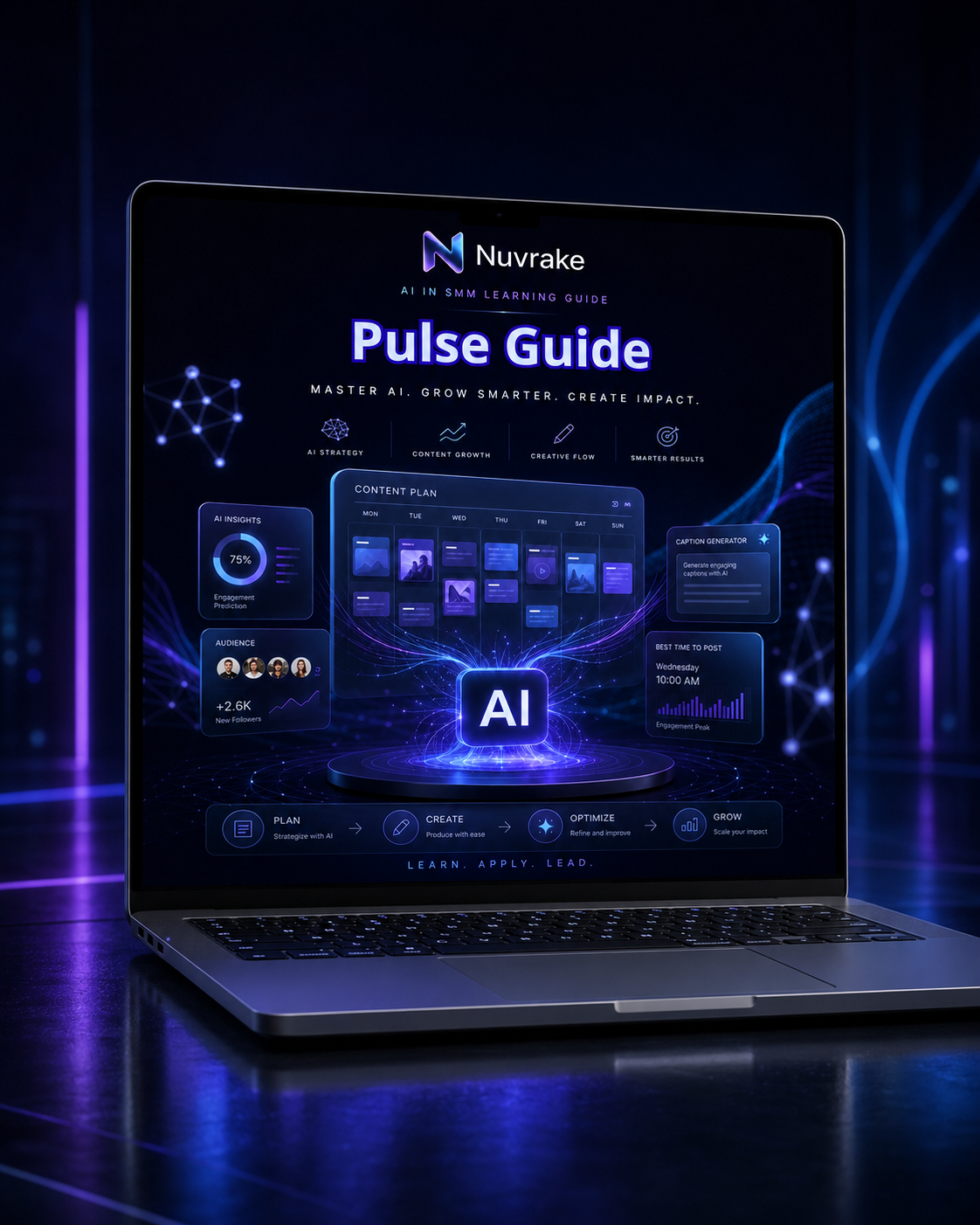
Pulse Guide
Pulse Guide
Couldn't load pickup availability
- 📁 Digital file available after purchase
- 🗂️ Long-term availability
- 🔐 Secure checkout
- 📝 Content updated in 2026
Self-paced learning overview
1. Problem Statement
After the first contact with AI, many people notice that random prompts lead to very different responses that are difficult to use in SMM work. Sometimes AI offers generic wording, repeats the same logic, or does not reflect the brand tone because the prompt does not include enough context. Because of this, the content process can feel scattered: ideas exist, but they do not form a consistent system. Another common question is how to separate a useful response from a weak draft that needs deeper editing. Pulse Guide was created to help organize early skills and learn how to work with AI in a more thoughtful way.
2. Solution
Pulse Guide offers a structured route where each module explains one part of working with AI for SMM. The course shows how to create prompts not randomly, but through a short logic: task, context, format, tone, details, boundaries, and response review criteria. This approach helps learners better understand why one response feels too general while another can become a useful base for editing. The materials also help with content categories, topics, drafts, short descriptions, and content planning at a steady pace. Pulse Guide works well as the next step after the starter set, when the learner wants not just to try AI, but to build a clear working process.
3. What’s Inside
Pulse Guide includes materials that help learners move from basic familiarity to a more organized way of working with AI in SMM. The course begins with a module about thinking before prompting. It explains why AI works better when the user does not simply ask it to “write something,” but describes the task, expected format, style, audience, and boundaries of the future material. This module helps learners see a prompt as a small content brief rather than a random phrase.
The second module focuses on context. You will review what details are useful to include in a prompt: brand topic, communication character, desired text length, message goal, audience type, wording examples to follow, and wording to avoid. It also explains how not to overload a prompt with unnecessary details, so the response stays readable and useful for further work.
The third module centers on content ideas. It includes prompt examples for finding topics, categories, post series, educational explanations, short comments, descriptions for visual materials, and different ways to present one topic in various communication moods. You will see how the same theme can be expanded into several directions: explanatory, analytical, educational, conversational, or editorial.
The fourth module is about draft structure. It explains how to ask AI to create not a final text, but a base for editing. This approach matters because a draft should not replace human editing. The materials show how to analyze a response: what to keep, what to shorten, where to add detail, where to remove repetition, and where to adjust the tone.
The fifth module includes a set of working schemes. These are short models for different SMM tasks: creating an idea, refining a topic, writing a heading, preparing a description, editing text, finding an alternative angle, and shaping a mini-plan for a content series. Each scheme is written so it can be adapted to different course themes, brand topics, or communication tasks.
The sixth module helps learners work with tone. In SMM, it is important not only what is said, but also how it sounds. Pulse Guide shows how to describe tone in prompts: calm, friendly, concise, analytical, editorial, educational, or softly promotional. It also explains how to ask AI to rewrite text without loud wording, pressure, or exaggeration.
The seventh module focuses on reviewing materials. It includes a checklist that helps evaluate a response before moving forward: whether the text matches the task, whether the structure is clear, whether it avoids empty phrases, whether it sounds too generic, whether the brand style is present, and whether more refinement is needed. This block is especially useful for learners who want not only to receive AI texts, but also to analyze them.
Pulse Guide also includes practical exercises. For example, the learner can take one topic and create three different prompts for it: one for an idea, one for structure, and one for a draft. Then the learner compares the responses, finds stronger and weaker parts, adds context, and observes how the material changes. This type of work helps learners better understand the connection between prompt quality and the quality of the received material.
4. Who Is This For?
Pulse Guide is for learners who have already tried AI for SMM but want to make their work more organized. It is a fitting choice for content writers, beginner and mid-level SMM specialists, small brand owners, editors, freelancers, and people who manage communication for their own services or learning materials.
This tier also suits people who often have many ideas but do not always know how to gather them into a clear content direction. Pulse Guide helps show how AI can support thinking stages: from topic to structure, from structure to draft, and from draft to edited material. The course does not replace the author’s view; it helps organize the work around it.
5. What You’ll Learn
- How to build AI prompts for different SMM tasks.
- How to add context without overload.
- How to describe brand tone in prompts.
- How to create topics, categories, and short content series.
- How to work with AI drafts as material for editing.
- How to review response quality before further use.
- How to rewrite general prompts into more precise ones.
- How to create several angles for one topic.
- How to reduce generic wording in texts.
- How to shape your own set of working AI schemes for SMM.
- How to combine AI ideas with brand voice.
- How to use checklists for reviewing learning and content materials.
6. 30-Day Payment Review Note
Pulse Guide includes a 30-day period for payment return requests if the materials do not match the tier description on the page or if technical issues occur when receiving the learning files. A request can be sent to the Nuvrake team within 30 days after checkout. We review such situations individually, compare them with the tier description and store terms, and help find an appropriate resolution. This section is created for clear communication between the user and the brand, without pressure, exaggeration, or loud claims.
Do I need previous experience with AI or SMM?
Do I need previous experience with AI or SMM?
No. Nuvrake courses are created so new topics are introduced gradually: from basic concepts to examples you can review at your own pace. The materials are suitable for people who are just getting familiar with AI in SMM, as well as for those who already work with content and want a more organized approach.
What format do the materials use?
What format do the materials use?
The learning experience is built through modules, written explanations, practical examples, checklists, working schemes, and individual tasks. Each tier has its own depth of content, but the general logic stays the same: clear structure, steady pacing, and focus on SMM tasks.
Can I study at my own pace?
Can I study at my own pace?
Yes, the materials can be reviewed in a rhythm that works for you. You can return to modules, reread examples, compare approaches, and gradually shape your own system for working with AI in SMM.
Share